Many business owners are not short of information. They can find articles, templates, webinars, podcasts and advice almost anywhere. What is often harder to find is the rhythm that turns advice into action: a clear diagnosis, a practical framework, someone to challenge their thinking, and a repeatable way to measure progress.
That is what makes business support franchises an interesting part of the franchise market. At their best, they do not simply sell expertise, they turn expertise into a system that can be trained, delivered, quality-controlled and repeated across different local markets.
For franchisors, this is a useful model to study because it shows how knowledge-led services can scale without losing the human element that makes them valuable.
The SME market creates the audience

The UK has a large and diverse small business base. FSB reports that at the start of 2025 SMEs accounted for 99.9% of the total UK business population, with 5.64 million SMEs, 16.9 million people employed and around £2.8 trillion in turnover. [source: fsb.org.uk]
That creates a substantial audience for practical business support, but it also creates a fragmented one. A sole trader, a growing family business, a local retailer, a professional services firm and a multi-site operator may all need support, but they will not need the same thing in the same way.
The government has also recognised the need to simplify how businesses access help. The Department for Business and Trade’s SME Action Plan referenced the Business Growth Service, designed to bring core business support services and the Growth Hubs network under one trusted banner.
For franchise brands in the business support space, this context matters. The opportunity is not just that SMEs exist in large numbers. It is that many of them need support that is structured, practical, and easy to apply.
Why business support can work as a franchise
Business support is personal, but it can still be systemised.
A good business coach, accountant, consultant, HR adviser or sales trainer brings judgement and experience. A good franchise model turns that experience into something more consistent: a methodology, a client journey, a toolkit, a training model and a clear way to deliver value.
This is where the franchise model can be powerful as it can take a service that might otherwise depend heavily on one individual’s knowledge and build a delivery system around it.
That system might include diagnostics, onboarding tools, workshop formats, coaching frameworks, reporting templates, client follow-up processes, local marketing assets, CRM systems, peer learning and ongoing professional development.
The franchisee still needs skill, credibility and relationship-building ability, but they are not starting from a blank page.
Case study: ActionCOACH

ActionCOACH is a useful example of a business coaching franchise because its proposition is built around turning coaching into a structured local business. Its UK franchise site describes the model as giving franchisees access to tools and systems, and states that it has more than 200 business coaches in the UK. [source: franchise.actioncoach.co.uk]
The interesting point is the way a broad and potentially intangible service, business coaching, is packaged into a model that franchisees can be trained to deliver – not just the size of the network.
For this type of franchise, the operating system matters. Franchisees need a clear method for attracting clients, diagnosing business needs, structuring coaching conversations, setting objectives and keeping clients accountable.
Without that structure, “business coaching” can become too vague. With the right structure, it becomes more understandable for the client and more repeatable for the franchisee.
Case study: TaxAssist Accountants
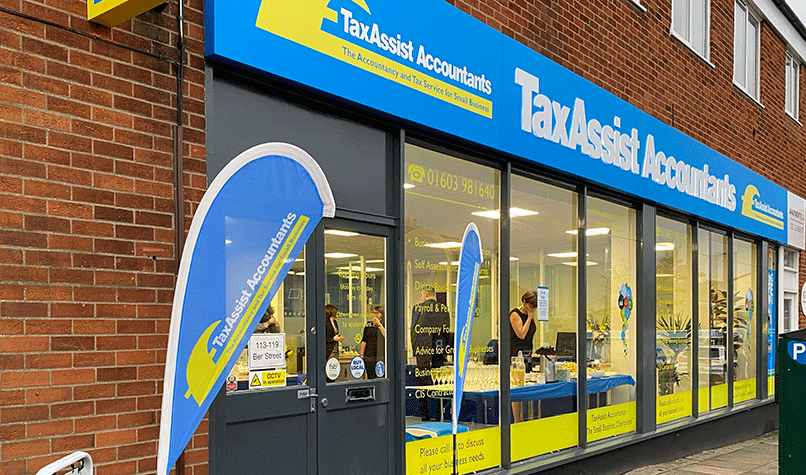
TaxAssist Accountants shows a different version of business support franchising.
Rather than coaching, the model sits around accounting, tax and advisory services for small business owners, self-employed professionals and personal taxpayers. TaxAssist describes itself as the UK’s largest network of accountants specialising in that market, operating from visible shopfronts, while the BFA states that it has over 250 franchises operating in the UK. [source: taxassistfranchise.co.uk]
This is a useful example because it shows how business support franchises can combine local presence with central systems.
For many SMEs, accountancy is not just a technical service, it’s is a relationship built on trust, accessibility and practical guidance. The local shopfront model makes the brand visible and approachable, while the franchise structure supports consistency, training, marketing and business development.
Business support does not always need to feel corporate or remote. In many cases, the value comes from making expert support easier to access locally.
What makes expertise franchiseable?
Not every expert-led service is automatically franchiseable.
1. A clear diagnostic process
The client needs a route into the service that feels structured. This could be a business review, financial health check, sales audit, HR assessment or growth planning session. A clear diagnostic gives the franchisee a consistent starting point and helps the client understand what needs attention.
2. A named methodology
Strong business support franchises usually have a recognisable way of working. That might be a coaching framework, planning model, sales process, reporting structure or advisory journey. The methodology gives franchisees confidence and gives clients something tangible to buy into.
3. A repeatable delivery rhythm
Expertise becomes more valuable when it is delivered consistently. Monthly coaching, quarterly reviews, scheduled reporting, workshop programmes and structured follow-ups all create rhythm. That rhythm helps turn advice into action.
4. Strong franchisee training
In business support, the franchisee is often the product. Their credibility, communication style, confidence and commercial judgement all shape the client experience. That makes training and ongoing development especially important. The franchisor needs to support not only technical knowledge, but also client management, sales ability, facilitation and local relationship-building.
5. Evidence of outcomes
Business owners are more likely to value support when they can see progress. That might be better financial visibility, stronger sales discipline, improved systems, clearer leadership, cleaner reporting or more confident decision-making. The more clearly a franchise can connect its work to useful outcomes, the stronger the proposition becomes.
The franchisor challenge
Business support franchises have a particular challenge: they need to be both structured and human.
Too little structure, and the model becomes inconsistent. Too much rigidity, and the service can feel scripted or generic.
The best models create a framework that helps franchisees deliver with confidence, while still allowing room for judgement, local knowledge and relationship-building.
That balance is important because SMEs are rarely looking for theory alone. They need practical support that fits the reality of running a business: limited time, competing priorities, cash flow considerations, recruitment challenges, customer demands and day-to-day operational decisions.
A strong business support franchise gives franchisees the tools to help clients move from knowing what they should do to actually doing it.
What the wider franchise sector can learn
The business support category offers a useful lesson for franchisors in any sector:
The more clearly a brand can codify its expertise, the easier it becomes to train others, support consistency and scale the model. That applies whether the franchise is selling coaching, tutoring, care, home services, fitness, children’s activities or hospitality.
The strongest franchise systems do not leave delivery to individual interpretation. They create a clear operating rhythm, then train and support franchisees to deliver it well. In business support franchising, that operating rhythm is the product.
It is the diagnostic, the framework, the conversation, the follow-up, the accountability and the local relationship. That is where the model becomes powerful.
A business support franchise is not just selling advice, it’s selling a repeatable way to turn expertise into action.