
KFC’s latest UK and Ireland growth plan could easily be seen as a straightforward confidence story; a major brand investing in new restaurants, creating jobs and strengthening its supply chain. For franchisors, though, the more interesting point is the timing.
This investment is being planned in a market where operating pressure has not gone away. Employment costs have risen, customers remain value-conscious and hospitality operators are still having to work hard to protect margins. Against that backdrop, KFC’s growth plan offers a useful case study in how a mature franchise brand can continue to expand while also investing in the infrastructure needed to support that growth.
It is a reminder that expansion in a pressured market needs to be more deliberate. The focus is not only on opening more locations, but on strengthening the wider commercial model around those locations; the estate, the people, the supply chain and the operating formats.
The pressure around the market
UK hospitality has been operating through a period of higher labour and employment costs.
From April 2026, the National Living Wage increased to £12.71 per hour for workers aged 21 and over. Employer National Insurance also changed from April 2025, with the secondary Class 1 rate increasing from 13.8% to 15% and the secondary threshold reducing from £9,100 to £5,000 per year.
For franchise brands, changes like this matter because they affect the economics at site level. Higher labour costs can influence staffing models, opening hours, service standards, pricing decisions, franchisee profitability and appetite for expansion. In food and beverage, where the model often depends on large frontline teams and consistent customer throughput, those pressures can be especially visible.
This is what makes KFC’s announcement worth looking at. The brand is not expanding in a pressure-free environment, it’s investing while the market remains challenging, which puts the quality and discipline of the growth strategy under closer scrutiny.
What KFC announced
KFC UK and Ireland announced a £1.49 billion investment plan as part of its 60th anniversary activity in the UK and Ireland.
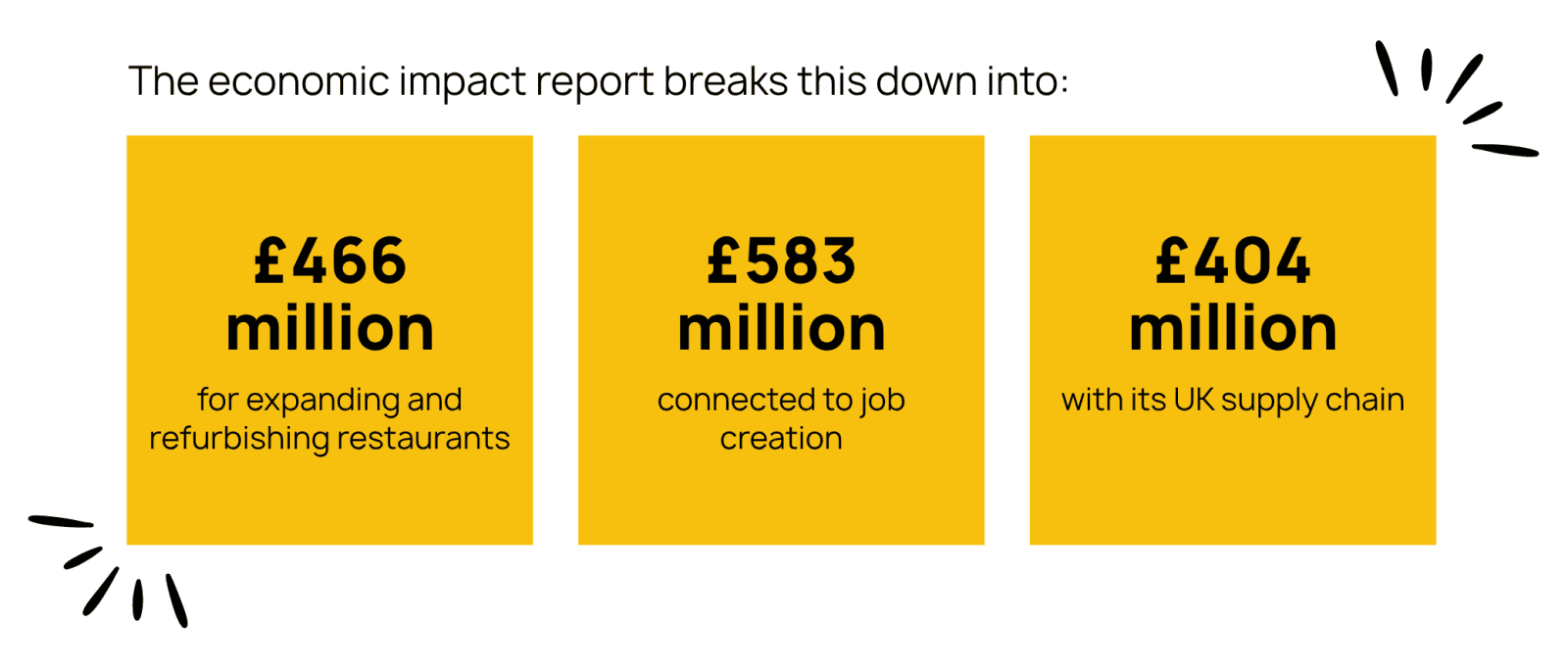
The wider plan includes opening 500 new restaurants across the UK and Ireland, with investment focused on new sites, flagship locations and drive-thrus, as well as upgrading more than 200 existing restaurants. The plan is also expected to create more than 7,000 jobs across KFC’s UK and Ireland business and supply chain.
KFC also reported that it and its 27 franchise partners directly employ 33,500 people across the UK and Ireland, and that it spends £856 million annually with UK-based suppliers.
The scale of those numbers is significant, but the useful franchise insight sits in where the investment is going. KFC’s plan is not only about footprint growth. It points to the different parts of a franchise system that need to work together if expansion is going to be sustainable.
Three areas franchisors should pay attention to

KFC’s plan includes new restaurants, flagship sites, drive-thrus and refurbishment of existing locations.
That matters because franchise growth is increasingly shaped by format. A drive-thru, a high street restaurant, a transport hub and a flagship site may all sit under the same brand, but the economics, staffing requirements, customer journey and local marketing needs can be very different.
For franchisors, this is an important reminder that expansion is not just about finding more locations. It is about understanding which version of the model is right for each market, and whether the franchisee proposition remains strong once local costs, customer behaviour and operational complexity are factored in.

KFC’s plan also includes significant investment connected to job creation.
That is important because people are not just an operating cost. They are central to consistency, service quality, speed, training and customer experience. As employment costs rise, franchisors need to think carefully about productivity, retention and the systems that help teams deliver the model well.
For franchise networks, the people model is part of the growth model. If a brand wants to expand, it needs to understand how operators will recruit, train, retain and develop the teams needed to deliver the experience consistently across locations.

One of the most interesting parts of KFC’s announcement is the level of investment linked to suppliers.
KFC’s report references £404 million with its UK supply chain, alongside its wider annual spend with UK-based suppliers. In the current environment, that is not a side detail. Supplier relationships can influence product availability, consistency, pricing, delivery reliability, franchisee confidence and the ability to keep opening new sites.
Recent years have shown how quickly disruption can reach operators through food costs, packaging availability, logistics, equipment delays and margin pressure. For franchisors, supplier strength is increasingly part of network resilience.
What the wider franchise sector can take from this
KFC is a large, mature brand, so most franchisors will not be working at the same scale. Even so, the underlying principles are relevant across the sector.
Growth under pressure needs clear unit economics, format discipline, practical support, operational consistency and supplier resilience. Franchisees need to know that the model works in current market conditions, not just in an ideal scenario. They also need confidence that the franchisor understands the pressures showing up at site level and is investing in the areas that make the biggest difference.
That might mean refining opening formats, improving training, strengthening local marketing, reviewing supplier arrangements, investing in better systems or becoming more selective about where the brand grows next.
The wider point is that expansion does not have to ignore difficult market conditions. In many cases, the strongest brands respond by becoming more disciplined about how they grow.
KFC’s growth plan is useful because it shows expansion being linked to restaurants, people, suppliers and formats, rather than treated as a headline number alone.
For franchisors, that is the real takeaway. Growth in a pressured market is still possible, but it needs to be built around the realities franchisees are operating in now.
Source note: KFC UK&I Economic and Community Impact Report, The Guardian, GOV.UK.